Nepal Is Not an Exception…
Why the Hindu Kush Himalaya must move from reacting to disasters to acting before they happen

The images from Nepal are devastating and difficult to absorb. Settlements buried under mud and debris. Roads and bridges torn apart and infrastructure built over years flattened. And families searching for those still missing.
In the immediate aftermath of any disaster, the first obligation is human relief efforts: to rescue those who can be reached, support the bereaved and displaced and restore access to water, shelter, health care and communication.
What we have learned so far suggests that the disaster may have been triggered by the displacement or collapse of glacial material, setting off a devastating chain reaction that culminated in severe flooding. Climatic changes across the Himalayan region are being considered contributing to the underlying instability. But the precise sequence of events and the role of climate change must be established through scientific evidence rather than inferred from dramatic images alone. Understanding this chain is essential both for understanding the causes but also for anticipating similar cascading risks elsewhere in the region.
But caution about attributing one event should not become an excuse for ignoring the hard to miss larger pattern. Nepal, like other countries of the region, sits within a region where a warming atmosphere and its associated impacts meet with expanding infrastructure and deep social vulnerabilities. Combining a chain of risks interplaying in such a manner to trigger catastrophe of such magnitudes.
A warning written into the Regional Geography
The Hindu Kush Himalaya is often called the “water tower of Asia”. Its ice, snow, rivers and ecosystems support about 240 million people in the mountains and a further 1.65 billion downstream. Twelve major river systems connect high-altitude changes to food, water, energy and livelihoods across South, Central and Southeast Asia.
A 2023 HI-WISE assessment by ICIMOD found that the region's glaciers disappeared 65 per cent faster during 2011-2020 than in the preceding decade. Under current high-emissions trajectories combined with other unstoppable trends, glaciers could lose up to 80 per cent of their present volume by 2100. Snow cover could decline by as much as one quarter. In the nearer term, accelerated glacier melt can increase runoff, expand glacial lakes and intensify flood hazards. Over longer periods, declining ice and snow reserves can alter the timing and reliability of water supplies for a vast region and segments of population.
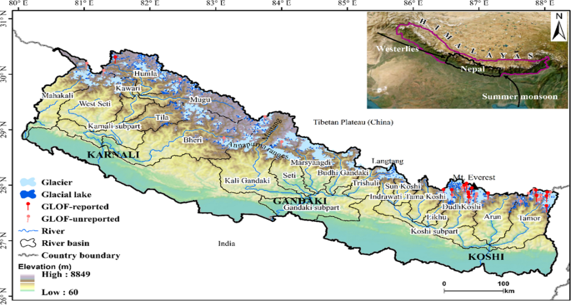
The danger is already visible and largely mapped. Once again, ICIMOD identifies more than 2,000 glacial lakes across the region, over 200 of them are considered dangerous. Around one million people across High Mountain Asia live within ten kilometres of a glacial lake and constantly exposed to severe flood risks.
Nepal's vulnerability is therefore geographical, developmental and institutional – all at the same time. The World Bank has warned that, without stronger resilience, climate impacts could make Nepal's economy at least 7 per cent smaller by 2050. For a country whose emissions are negligible in global terms, that is a profound expression of climate injustice.
Risk is a Chain, Not a Single Event
We development and disaster risk practitioners have learned that hazard of flood turns into a disaster when it encounters exposed people and fragile infrastructure. Combined with poverty, environmental degradation and incapacity of institutions to respond in time. But climatic and atmospheric conditions alone do not determine who lives, who loses a home, or whose recovery lasts for years. The outcome is shaped by decisions made long before the rain falls or glacial outbreak turns into havoc across with transboundary impacts.
This is applicable across all regions and geographies but particularly important for the Hindu Kush Himalaya region because risks cascades across sectors and borders.
The Compelling Case for Early Action
While its commonly known that not every disaster can be prevented but a foreseeable hazard should not repeatedly be allowed to become a human catastrophe. This is where early action becomes imperative. It essentially means intervening in the space between knowledge of risk and the moment of impact. That space may be measured in decades when deciding where to build infrastructure. Or in seasons when planning for monsoon or drought. It comes down to days when forecasts trigger the release of finance. And in minutes when a warning prompts evacuation.
The World Meteorological Organization reports that early-warning services can provide up to ten-fold return on investment. A warning issued 24 hours before a storm or heatwave can reduce ensuing damage by about 30 per cent. These are startling figures. On practical level, an estimated US$800 million invested in early-warning systems across developing countries could potentially avoid US$3-16 billion in losses each year. Countries with good early-warning coverage experience disaster-related mortality about six times lower than countries with limited coverage. Not abstract benefits but these are lives saved, livestock moved somewhere safer. Crops harvested earlier and preserved.
There are many replicable examples around the world to learn from. Bangladesh powerfully demonstrated what sustained preparedness can achieve. Before Cyclone Amphan struck in 2020, forecasts and organised action enabled the evacuation of nearly two million people and 500,000 livestock, supported by more than 12,000 cyclone shelters. Bangladesh has not eliminated cyclone risks but managed the risks by diminishing exposure of people and assets.
What Acting Early Would Mean in the Himalaya
For the Hindu Kush Himalaya, early action must begin with a regional understanding of risks. Rivers, glaciers, weather systems and debris flows do not stop at political borders. Upstream observations in one country can warn and trigger pre-emptive action for downstream communities. Sharing near-real-time hydrometeorological and cryosphere data is therefore not a diplomatic courtesy. It is life-saving information and must be treated as a regional public good for the benefit of public.
In this context, a comprehensive and evident based early action system may include following:
First, map multi-hazard chains, not hazards in isolation. Glacial lakes, unstable slopes, extreme rainfall, river blockages, sediment loads, hydropower sites, roads and settlements must be analysed together at catchment level. Risk maps should guide land-use decisions, infrastructure design and evacuation planning.
Second, invest in monitoring and last-mile warning reach. Satellite observation, automatic weather and river gauges, lake and slope monitoring and better forecasting are essential. Complemented by structured preparedness by the local and community led institutions. Technology can detect danger but socially driven mechanisms turn a warning into action.
Third, connect forecasts to pre-agreed finance. Given the recuring fiscal challenges, this is the most challenging step and ask but governments and humanitarian agencies should establish thresholds that automatically release funds before an expected event. The goal is not to predict every event but to make prudent, low-regret decisions before the cost multiplies.
Fourth, screen infrastructure designs from a climate and disaster risk perspective before building them. A bridge, mountain road or hydropower plant expected to operate for decades cannot be designed from historical averages alone. Project appraisal must include upstream cryosphere change, compound rainfall and landslide risk, sediment, safe-failure scenarios and the consequences for downstream communities.
Fifth, protect the people least able to absorb losses and damages. Shock-responsive social protection, accessible shelters, livelihood diversification, insurance and contingency finance must be designed before a crisis. Otherwise, the poorest households pay for climate shocks by selling productive assets, taking children out of school or migrating under distress.
From Disaster Response to Anticipatory Governance
Myopically, governments are judged by the speed of relief post disaster. However, they should also be held accountable by what they did with the warnings available before the disaster strikes. This requires a shift in political and financial incentives which so far have proven be to hardest shift to happen. Reconstruction is visible and urgent. Whereas, prevention is less visible because its success is measured in disasters that did not occur, lives that were not lost and assets that remained standing.
This shift in approach demands to internalise that early action is not an alternative to mitigation, adaptation or loss-and-damage finance. Anticipatory action protects people when a specific hazard becomes imminent. Pre-arranged finances ensure that governments do not have to improvise funding after the disaster impacts.
Back to Nepal is Not an Exception
Eventually, the waters will recede, the debris will be cleared, roads will reopen, and the damage will be counted. International attention will move on. However, for many families, the disaster will continue for years through debt, displacement, lost income, interrupted education, and grief.
This tragedy should leave us with more than sympathy and another promise to rebuild. It should force harder questions, because the warning is not Nepal's alone. If the risks are becoming clearer and more measurable, why do finance, institutional attention, and political urgency still arrive mainly after lives and assets have already been lost?
I may repeat once again that Nepal is not an exception. It is a warning!