Nepal Is Not an Exception…
Why the Hindu Kush Himalaya must move from reacting to disasters to acting before they happen

Devastation caused by glacial outbreak in Nepal was deeply disturbing but not necessarily unprecedented. Global and regional climate data point to a growing likelihood of more frequent and severe events of this kind.
The exact causes of the disaster are still being investigated from. But it is largely understood that the disaster may have been triggered by the displacement or collapse of glacial ice that had been weakening due to surface temperatures increase. Setting off a damaging chain reaction that culminated in severe flooding and damaging several large hydropower plants. However, the precise sequence of events, including the role of climate change, must be established through scientific evidence rather than inferred from news reports or dramatic images. Understanding that sequence is essential not only for explaining what happened in Nepal, but also for anticipating similar cascading risks elsewhere in the region and beyond.
Caution is necessary, but it should not become an excuse for disregarding the pattern that is already visible. Nepal, amongst other countries of the region, lies in a zone of distinctive climatic, geographic and atmospheric conditions where warming temperatures and other climate shifts are intensifying already serious vulnerabilities and multiple risks.
A Warning Written into the Regional Geography
The Hindu Kush Himalaya is often called the “Water Tower of Asia”. Its ice, snow, rivers and ecosystems support about 240 million people in the mountains and a further 1.65 billion downstream across the Asian region. Twelve major river systems link high-altitude landscapes to densely populated lowlands, creating sensitive atmospheric and ecological conditions. Because communities depend heavily on natural systems facing deep social vulnerabilities, even relatively small climatic shifts bear severe consequences for food, water, energy and livelihoods across South, Central and Southeast Asia.
A 2023 HI-WISE assessment by ICIMOD found that the region’s glaciers disappeared 65 per cent faster between 2011 and 2020 than in the previous decade. Under continued high emissions and rising regional average temperatures, glaciers could lose up to 80 per cent of their volume by 2100. While snow cover could decline by as much as one quarter. In the near term, accelerated glacier melt can increase runoff, expand glacial lakes and heighten flood hazards across the entire region.
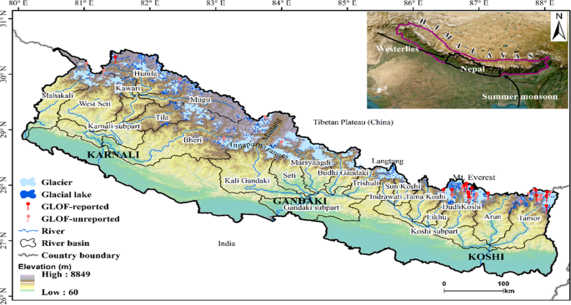
The dangers created by these rapid climatic changes are already visible and well researched and documented. ICIMOD has identified more than 2,000 glacial lakes across the region, with over 200 considered as dangerous. Around one million people in high mountain areas live within ten kilometres of a glacial lake – exposing them to potentially severe flood risks.
Like other countries of the region, vulnerability of Nepal is simultaneously geographical, developmental, and institutional. The World Bank has warned that, without stronger resilience, climate impacts could leave Nepal’s economy at least 7 per cent shrunk by 2050.
For countries across the Global South, this is not only a question of better forecasts, stronger embankments or safer infrastructure. It is a question of their economic, social and in some case physical survival. And from global perspective, it is a matter of climate justice. Communities that contributed least to global emissions are being forced to absorb escalating climate risks with limited fiscal space combined with constrained institutions.
Risk is Built Before Disaster Arrives
Disaster risk practitioners have long recognised that a flood hazard becomes a disaster when it reaches exposed people and fragile infrastructure. When poverty, environmental degradation and weak institutional capacity are added, the risks multiply manifold. Climatic and atmospheric conditions alone do not determine who survives, who loses a home or whose recovery lasts for years. Those outcomes are shaped by decisions made long before rain falls or a glacial outbreak causes transboundary damage.
This logic is applicable across regions and geographies, but it is particularly important for the Hindu Kush Himalaya region where risks cascade across sectors, communities and borders.
The Compelling Case for Early Action
Not every disaster can be prevented. But foreseeable hazards should not repeatedly become human catastrophes. Fittingly planned and designed early action can minimise the risks. Essentially intervening in the space between knowing that a risk exists and the moment it may trigger the harm. This space may be measured in decades when deciding where to build essential public infrastructure, in seasons when planning for monsoon or drought in days when forecasts trigger preparedness financing. And in minutes when warnings prompt evacuation.
“A warning issued 24 hours before a storm or heatwave can reduce damage by about 30 per cent — delivering up to a tenfold return on investment.”
World Meteorological Organization · Disaster Risk Data
The World Meteorological Organization reports that early-warning services can deliver up to a tenfold return on investment. A warning issued 24 hours before a storm or heatwave can reduce damage by about 30 per cent. In practical terms, an estimated US$800 million investment in early-warning systems across developing countries could prevent US$3–16 billion in losses each year. Countries with strong early-warning coverage experience disaster-related mortality about six times lower than those with limited coverage.
Bangladesh offers a powerful demonstration of what sustained preparedness can achieve. Before Cyclone Amphan struck in 2020, forecasts and organised action enabled the evacuation of nearly two million people and 500,000 livestock, supported by more than 12,000 cyclone shelters.
Bangladesh has not eliminated cyclone risks but it has reduced exposure by moving people and assets out of harm’s way before impact.
What Acting Early Would Mean in the Himalaya
For the Hindu Kush Himalaya, early action must begin with a regional understanding of risks. Rivers, glaciers, weather systems and debris flows do not stop at political borders. Upstream observations in one country can help warn and trigger pre-emptive action for downstream communities in another. Sharing near-real-time hydrometeorological and cryosphere data is of paramount importance.
In this context, a comprehensive and evidence-based early-action system should include five priorities:
First, map multi-hazard chains. Not hazards in isolation. Glacial lakes, extreme rainfall, river blockages, sediment loads, hydropower sites, roads and settlements must be analysed together at catchment level. Risk maps should guide land-use decisions, infrastructure design and evacuation planning.
Second, invest in monitoring and last-mile warning systems. Satellite observation, automatic weather and river gauges, lake and slope monitoring, and improved forecasting are essential. These must be complemented by structured preparedness through local institutions and community-led mechanisms.
Third, connect forecasts to pre-agreed finance. Given recurring fiscal constraints, this may be one of the hardest demand. But governments and humanitarian agencies should establish thresholds that automatically release funds before an expected event. The goal is not to predict every event with certainty but to enable prudent, low-regret decisions before costs multiply.
Fourth, screen infrastructure designs for climate and disaster risk before construction begins. A bridge, mountain road or hydropower plant expected to operate for decades cannot be designed on historical averages alone. Project appraisal must account for upstream cryosphere change, compound rainfall and landslide risk, sediment loads, safe-failure scenarios and potential consequences for downstream communities.
Fifth, protect the people least able to absorb loss and damage. Shock-responsive social protection, accessible shelters, livelihood diversification, insurance and contingency finance must be designed before a crisis. Otherwise, the poorest households pay for climate shocks by selling productive assets, taking children out of school or migrating in distress.
From Disaster Response to Anticipatory Governance
Governments are often judged by the speed of relief after a disaster. They should also be judged and held accountable to actions and measures taken with the warnings available before disaster struck. It requires a shift in political and financial incentives, which has so far proven difficult. Reconstruction is visible and urgent. Prevention is less visible because its success is measured in disasters that did not occur.
This shift requires recognising that early action is not an alternative to mitigation, adaptation or loss-and-damage finance. Anticipatory action protects people when a specific hazard becomes imminent. Pre-arranged finance ensures that governments do not have to improvise funding after disaster impacts have already begun.
A Global South perspective also requires asking who pays for preparedness. The countries facing the most acute and most immediate climate risks cannot be expected to finance early warning, resilient infrastructure and pre-arranged response systems mainly from already stretched public budgets. International climate finance must become faster, easier to access and more willing to fund risk reduction before disasters occur, rather than arriving too late as fragmented support for recovery and reconstruction.
Back to Nepal is Not an Exception
This tragedy should leave us with more than sympathy and another promise to rebuild. It should force harder questions, because the warning is not restricted to Nepal alone. If the risks are becoming clearer and more measurable, why do finance, institutional attention, and political urgency become available after lives and assets have already been lost?
Nepal is not an exception. It is a warning.