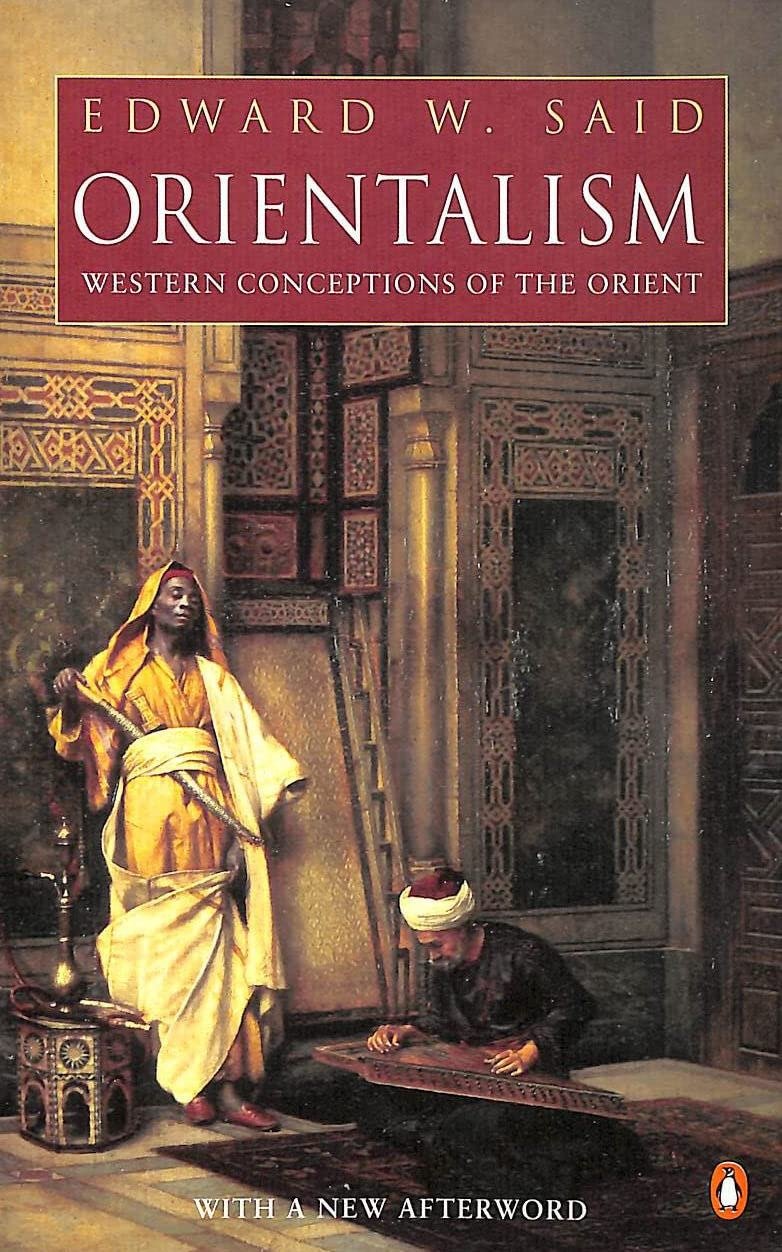
What I took from it
For me, this remains the enduring power of Orientalism. It did not give me a replacement doctrine. It gave me a discipline of mind to receive knowledge with openness and to separate institutional authority from intellectual truth.
I first read Edward Said's Orientalism while studying for my Master's in Economic and Social Studies back in 1998. It was a difficult read and unsettling in its main argument. It raised so many questions about the system and neutrality of knowledge itself that I felt myself intellectually uprooted. It disturbed the ground on which I believe knowledge itself stands.
By the time I finished reading it, I had not only gained a new set of facts about East and West. I had developed a very different understanding of what a fact, a theory and even an academic discipline can do in shaping the world.
There is an interesting and deeply personal background to my first interaction with Orientalism. I had moved from Pakistan to the UK with the pure intention of seeking education from the western academic systems and institutions, carrying many of the assumptions that my formal education quietly placed within me. Many pre-conceived ideas of east and west. Being intellectually raw and academically in formation, I was dominantly susceptible to subtle prejudices well entrenched in the system of knowledge created through the western academic apparatus and arrangements. I had been trained to regard established theories, particularly those bearing the authority of Western universities and intellectual traditions, as largely neutral descriptions of unquestionable reality.
Orientalism confronted me with an alternative and more unsettling possibility: knowledge may explain the world but it may also arrange it in certain ways. If undertaken systematically, it can classify people, assign civilisations a place in history, turn difference into deficiency. Above all, promote an intellectual language through which unequal power begins to appear natural. This was profound and it affected me profoundly.
It fundamentally changed the way I approached and questioned knowledge. I was no longer asking, "Is this theory persuasive and fitting to my perceptions?" I also began to ask: Who produced it? What history made this way of seeing possible? What historical accounts and sociological values it encapsulated? Who is allowed to speak within it, and who appears to be reduced as an object to be described? Most importantly, what relations of power are concealed when a particular experience presents itself as universal truth?
Knowledge and Power
Published in 1978, Orientalism is often described as a study of how the West represented the East. That description is somewhat important but certainly insufficient. The deeper argument of the book is about the intimate interlinkage between knowledge and power. The 'Orient' was not simply a place waiting to be accurately observed. Over centuries, it was made into an intellectual object through scholarship, literature, travel writing, political administration and art. These different forms of representation accumulated into a system of thought which is highly biased and inaccurate. Within that system, the East is painted as timeless, irrational, sensual, despotic, passive or incapable of governing itself. While the West appeared modern, rational, disciplined and active.
The importance of this argument lies not merely in showing that these descriptions were deliberately biased and blatantly prejudiced. Prejudice can be corrected with better information and honest observation. Orientalism identified something more structural: a framework that decided in advance which descriptions would appear credible. Once a civilisation is defined as backward, generic societal norms become evidence of its backwardness; every act of resistance is perceived as an act of irrationality, justifying every external intervention as guidance, reform or rescue.
Orientalism argues that this system of knowledge building is so subtle that it does not require every scholar or official to be consciously deceptive. A person may be sincere, rigorous and convinced of their objectivity but still work inside categories inherited from an unequal past. The archive precedes the observer and established vocabulary precedes the conclusion. Knowledge can therefore reproduce domination without announcing itself as propaganda.
Recognizing Authority
This is why Orientalism is more than a book about inaccurate images. It is a book about the authority to describe. This distinction is crucial. Said was not arguing that all knowledge about other societies is necessarily false, nor that cultures can be understood only by those born within them. Such a position would make genuine learning across civilisations impossible. The problem begins when interpretation becomes monopoly—when one tradition acquires the power not only to describe another but also to decide which account is authoritative.
I came to see that representation has ethical consequences. The question is not simply whether an account contains factual errors. It is whether it allows the people it describes the same humanity, internal disagreement and capacity for change that the observer grants to himself. A civilisation is misrepresented not only when it is presented in a certain way but also when it is denied complexity.
After Orientalism, I could not approach international relations, sociology, anthropology or development studies in quite the same way. Their theories remained valuable but their authority was no longer automatic. They were always open to questioning. I began to read both with and against a text, trying to understand a theory on its own terms while also looking for its silences—the language it uses in qualifying representation or justifying exclusions.
The book taught me to distinguish intellectual scepticism from cynicism. To question a theory is not to dismiss evidence, expertise or disciplined inquiry. It is to refuse the surrender of judgement. The more mature task is to identify both what a framework reveals and what its history prevents it from seeing.
Finding My Own Standpoint
Over time, Orientalism helped me develop my own perspective. By this I do not mean that I discovered a pure or exclusively Eastern point of view. There is no such uncontaminated position. But I learned that it is possible to learn deeply from Western scholarship while still questioning the universality of its claims—to value a theory without becoming captive to it and to bring one's own history into the act of judgement.
This habit stayed with me in my later professional life, including my work with governments, international institutions and global negotiations. I often encountered policies presented as universally valid but designed within institutional contexts far removed from the societies expected to implement them.
Developing one's own perspective is not an act of intellectual isolation. It is a demanding form of participation. It requires reading widely without being overawed, listening seriously without becoming submissive, and questioning one's own inherited assumptions with the same force used to question others.
For me, this remains the enduring power of Orientalism. It did not give me a replacement doctrine. It gave me a discipline of mind to receive knowledge with openness and to separate institutional authority from intellectual truth. Orientalism taught me not what to think, but rather to ask where thought stands—and, in doing so, helped me find a place from which I could think for myself.